Can AI prepare you for technical interviews?

For technical interviews, AI is most useful as a drilling partner: unlimited practice problems, instant explanations of an approach you did not see, and pressure-free repetition of the patterns that recur — sliding window, two pointers, graph traversal, dynamic programming. That is genuinely faster than working alone. What it does not build is the thing coding rounds actually test, which is thinking out loud while writing code someone else is watching. Interviewers grade communication and recovery at least as much as the final solution, so pair AI drilling with practice where you narrate every step, and verify anything version-specific it tells you before repeating it.
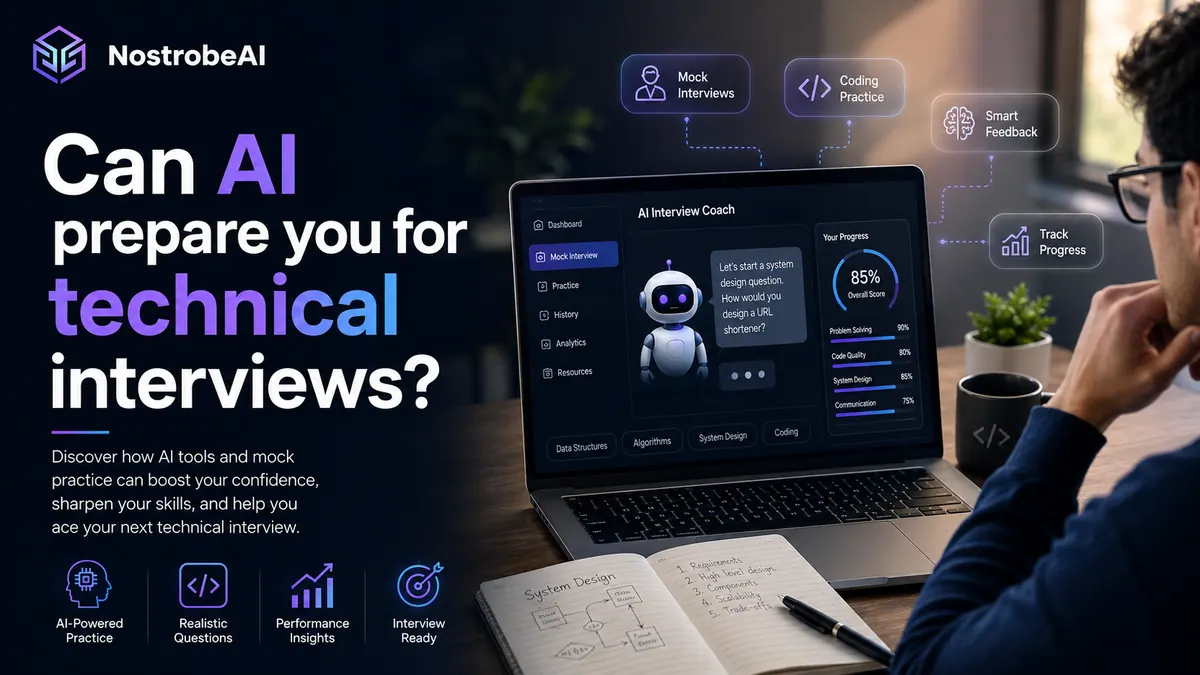
Yes, it can, but only if you use it like a practice partner and not a crutch. The strongest use of AI is before the interview, where it can drill you on coding, system design, and explanation skills, then point out the exact spots where your thinking falls apart.
What does AI help with first?
The most useful AI tools for technical interview prep are the ones that simulate real interview pressure. They give you a coding problem, wait for your reasoning, then push back with follow-up questions about edge cases, time complexity, or trade-offs, which is much closer to a real round than solving isolated problems on a whiteboard. That matters because technical interviews are rarely just about getting the final answer. They are about how you get there and whether you can defend it under pressure.
A good example is a backend candidate practicing hash maps and binary trees. AI can ask the first question, then follow up with “what if the input is empty?” or “how would this change if the data came in a stream?”. That kind of back-and-forth helps you stop treating interview prep like memorization and start treating it like problem-solving out loud.
Why does it work better than passive study?
Watching solutions is easy. Explaining them cleanly is hard. AI mock interviews force you to do the hard part.
When you practice with AI, you are not just solving for correctness. You are practicing how to speak while thinking, how to organize your answer, and how to notice when you are drifting into vague territory. That is especially helpful in system design interviews, where tools like mockingly.ai ask open-ended design questions and keep pressing until your answer has shape and logic. One session might start with “design a chat app,” then move into storage, scaling, and bottlenecks once your first answer is on the table.
A practical example helps here. Suppose you are building a payment system design. The AI might ask about retries, idempotency, or failure handling. If you never explain those parts in practice, you will probably freeze when a human interviewer asks. With AI, you can rehearse that discomfort early, while the stakes are still low.
Where it saves time
AI is good at finding weak spots fast. Instead of spending two hours on random questions, you can ask it to focus on graph algorithms, concurrency, or object-oriented design, depending on the role you want. That targeted practice matters because technical interviews punish shallow preparation. A candidate who can solve easy arrays but falls apart on recursion is not ready yet, and AI makes that gap obvious sooner.
It also helps with repetition, which sounds boring but is the whole point. If you keep missing the same pattern, AI can generate another version of it immediately. You do not have to wait for a study partner or scroll through fifty unrelated problems. That fast loop is one of the main reasons these tools feel useful in real prep.
The part that people overestimate
AI is not good at thinking for you when the question gets messy. It can help explain a concept step by step, and that is useful, but it can also sound confident while being wrong. That is the big trap. If you accept every answer at face value, you are training yourself to trust a machine more than your own understanding.
That becomes a real problem in technical interviews because interviewers are watching for judgment, not just output. If you use AI to study a coding pattern but cannot explain why the pattern works, you are only half prepared. I have seen this happen with candidates who can repeat the right answer but cannot adapt when the interviewer changes one small detail. The moment the question shifts, the memorized solution collapses.
There is also a second risk. AI can make you feel more prepared than you are. You finish a mock session, get polished feedback, and think you are ready. Then the actual interview asks something slightly different, and your brain blanks. That gap is why AI should be treated as rehearsal, not proof.
A concrete way to use it well
The best way to use AI for technical interview prep is to build a small routine around it. Start with one topic, maybe dynamic programming, backend design, or SQL. Ask the AI to quiz you, answer out loud, then ask it to challenge your solution or point out missing edge cases.
For example, if you are preparing for a frontend role, you can ask questions on React state management, rendering behavior, and browser performance. After answering, have the AI critique whether your explanation was too shallow or too long. If you are preparing for a data engineering role, ask it to test you on data pipelines, retries, and failure handling, then make you justify your choices. That kind of practice feels slower than just reading notes, but it sticks.
Another useful habit is to make AI check your explanation, not just your code. Interviewers care a lot about the story behind your answer. They want to know why you picked a certain approach, what trade-offs you accepted, and what you would do if the constraints changed. AI can help you practice that narrative, which is one of the most overlooked parts of technical prep.
What about live interview help?
This is where things get messy. Some tools are built for real-time assistance during the interview itself, but that sits in a gray area and depends heavily on the company and the round. Google is already piloting an AI-assisted coding interview format where candidates can use an approved AI assistant during a code comprehension round, and interviewers assess how well they read, debug, and validate AI output. That is a very specific case, not a free pass for everyone.
For most candidates, live AI help is not the real value anyway. The real win is better prep. If you can already solve the problem, explain your reasoning, and catch AI mistakes, then you are in a much stronger position than someone hoping a tool will carry them through the interview. That difference matters more than people admit.
What do interviewers still care about?
Even in a world where AI tools are everywhere, interviewers still want the same basic things. They want clear reasoning, clean code, and the ability to handle follow-up questions without panicking. They also want honesty. If you lean on AI during prep, that is normal. If you lean on it blindly in a real interview, you risk looking like someone who can copy an answer but cannot own it.
That is why AI is best used as a strict practice partner. It can expose weak spots, speed up repetition, and make your study time more focused. It cannot replace the pressure of a real interview room, and it should not try to. The strongest candidates use AI to sharpen their thinking, then walk into the interview ready to explain every choice without needing a machine to finish the sentence.
Frequently asked questions
Can AI replace LeetCode practice?
No, but it changes what practice costs. AI is best used alongside problem sets: solve first, then use AI to explain the approach you missed or to generate variations on a pattern you keep failing. Reading AI solutions without attempting the problem first builds very little.
Does AI help with system design interviews?
Partly. It is useful for learning the standard components and rehearsing the six-step framework, and much weaker at the trade-off reasoning that senior rounds actually grade. It also tends to produce over-engineered designs, which is the exact failure mode interviewers penalise.
Will AI teach me to communicate during a coding interview?
Not on its own. Communication is graded on how you narrate uncertainty, ask clarifying questions and recover from a wrong turn. Practise by speaking every step aloud while you solve, then check whether your explanation would make sense to someone who could not see your screen.
How accurate is AI on technical questions?
Reliable on well-established fundamentals, noticeably less so on recent library versions, edge cases and anything niche. Check anything you plan to assert in an interview, because a confidently wrong answer costs more than saying you are not sure.