
Does AI provide interview feedback?

Yes, and the feedback is most reliable on the mechanical layer: answer structure, pacing, filler words, how long you spoke, and whether you actually answered the question asked. Those are measurable, so the assessment is consistent in a way human feedback often is not. It is far weaker on substance — whether your example was impressive for the level, whether the story would survive a follow-up, whether you built rapport. Read AI feedback as instrumentation rather than judgement: it reliably tells you what you did, and you still need a person to tell you whether what you did was good enough.
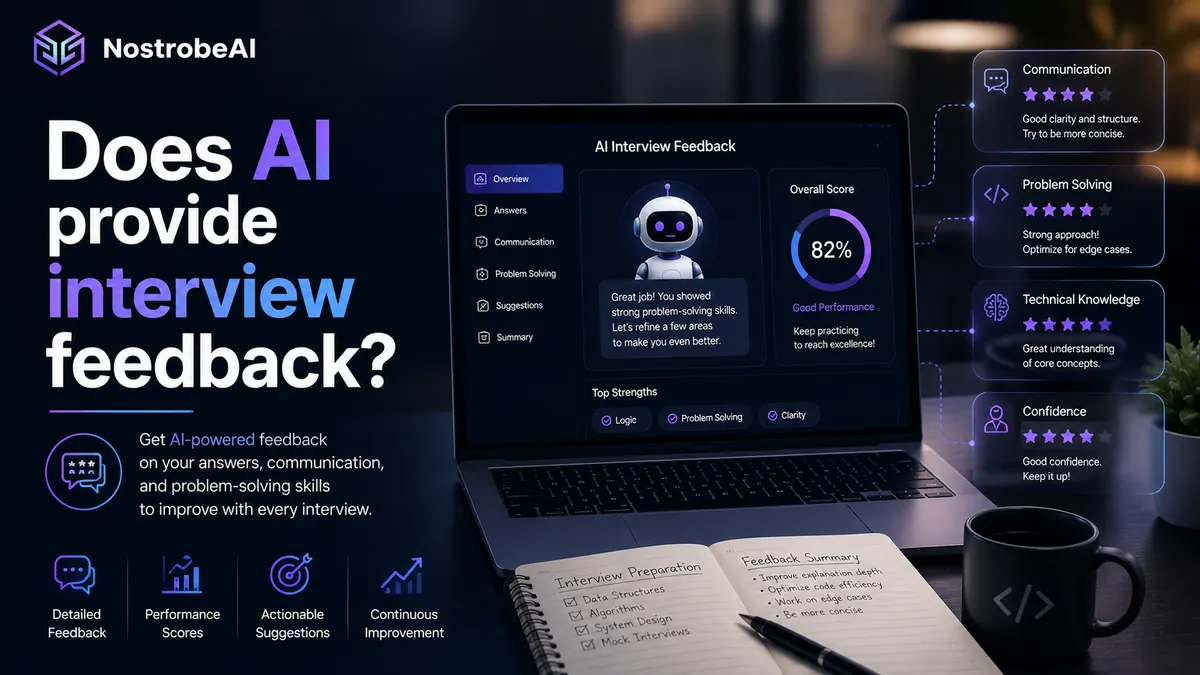
Yes, it does, and in a pretty detailed way now. The better tools can look at your answers, your voice, your pace, even your body language, and then give you feedback that is specific enough to fix, not just flattering enough to feel good.
What does AI feedback actually look at?
Most AI interview tools start with the basics: what you said, how clearly you said it, and whether your answer actually matched the question. From there, some tools go deeper and measure speech patterns like filler words, pacing, tone, and pauses. Others add video analysis, so they can flag eye contact, facial expression, and other non-verbal habits that show up when someone is nervous or overthinking.
That sounds fancy, but the logic is simple. If you keep saying “um” every third sentence, the AI notices. If your answer is correct but scattered, the AI notices that too. If you sound confident but keep skipping the actual result in a STAR answer, it catches that as well.
How does the feedback get generated?
Under the hood, most AI mock interview platforms use speech recognition and NLP to turn your spoken answer into text, then compare that transcript against a scoring rubric. Some systems also use sentiment analysis to read tone and confidence, which is why the feedback can mention things like monotone delivery or rushed speaking. In many tools, the result is broken into sections such as content, delivery, clarity, and structure, so you can see where the answer went off track.
A practical example makes this easier to picture. Say you answer, “I led a project that improved performance.” That sounds fine on the surface, but AI feedback might say the answer is too vague because it never explains what you changed, how you measured success, or what result you got. A human interviewer might feel that weakness too, but the AI can flag it immediately and often more consistently.
Why do people find it useful?
The biggest strength is speed. You do not have to wait for a friend, a mentor, or a recruiter to tell you that your answer was too long or that you buried the main point halfway through. AI gives feedback right after the session, which means you can run the same question again and see whether you improved on the next try.
That matters a lot for technical interviews. A backend engineer can use AI to practice explaining trade-offs in a system design answer. A frontend candidate can use it to spot rambling when describing state management or rendering behavior. A fresher can use it to see whether their answer sounds structured or just memorized. The feedback is not magic. It is just fast, specific, and repeatable, which is what most people need when they are practicing alone.
A real example of feedback in action
Picture a candidate preparing for an SDE role. They answer a question about conflict in a team and spend two minutes describing the problem, but never explain what they did. AI feedback might say the answer is strong on context but weak on action and result. It may also point out that the candidate spoke too quickly and used several filler words near the end.
That feedback is useful because it tells the candidate exactly what to fix next time. On the second attempt, they can shorten the setup, add one concrete action, and end with a result like, “We reduced review time by two days.” That is the kind of improvement AI helps with best. It does not write the answer for them. It shows them where their answer is thin.
Where is AI feedback strong?
AI is good at pattern spotting. It can measure pacing, count filler words, and check whether your answer has a clear structure. It can also give you a useful baseline if you are not sure how you sound on camera or whether you ramble under pressure. For many candidates, that alone is a big step up from practicing in their heads.
But it is not perfect. AI can misread accents, cultural speech habits, or communication styles that do not match the data it was trained on. It can also reward polished delivery even when the actual thinking is weak. That is why the best use of AI feedback is as a first pass, not the final word. A human coach can still catch things a scoring engine misses, like whether your answer sounds genuine or whether your tone fits the role.
Does it help with technical interviews too?
Yes, especially when the feedback is tied to actual technical practice. Some tools let you practice coding rounds, system design questions, or role-specific interview prompts, then give you comments on how you explained your logic. That is helpful because technical interviews are not only about getting the right answer. They are also about walking the interviewer through your thinking without getting lost halfway through.
For example, if you are solving a binary tree problem and never explain the time complexity, AI feedback can flag that gap right away. If you are doing system design and keep jumping between database choice, caching, and scale, it can indicate that your answer lacks flow. Those small corrections matter more than people think, because a messy explanation is often what makes a decent answer sound weak.
What to do with the feedback
The best way to use AI interview feedback is to work on one issue at a time. If the tool says you speak too fast, do not try to fix your tone, structure, and body language in the same session. Slow down first. If it says your answer is too vague, add one concrete example before worrying about eye contact.
Here is a simple routine that works well. Run one mock interview. Read the feedback. Pick the single weakest part. Repeat the same question and test that one fix. Then move to the next issue. That loop is boring, but it works. The people who improve fastest are usually the ones who use the feedback in small, stubborn steps rather than trying to rewrite everything at once.
So, is AI feedback enough on its own?
Not really. It is useful, sometimes very useful, but it is still a tool. AI can tell you that your answer was too long, too fast, too soft, or too thin on detail. It cannot fully judge whether your story sounds believable to a hiring manager or whether your personality fits a team. That part still needs a human read.
The cleanest way to think about it is this: AI feedback helps you become easier to listen to, easier to understand, and easier to follow. That is a real advantage in interviews. But the actual job of sounding thoughtful, honest, and ready still belongs to you.
Frequently asked questions
What does AI interview feedback actually measure?
Mostly observable features of delivery: how long you spoke, pace, filler words, whether the answer followed a recognisable structure, and whether it addressed the question. Some tools also check for a stated result or metric, which is why structured answers score better.
Is AI feedback accurate?
Consistent is the better word. On measurable things like pacing and structure it is dependable. On substance — whether your example is strong for the seniority you are targeting — it is guessing from patterns and can be confidently wrong.
Can AI tell me if my answer was actually good?
Only partly. It can tell you the answer was well structured and correctly scoped. It cannot tell you whether the project you described reads as impressive to someone hiring at that level, which is exactly where a human reviewer is worth more.
How should I use the feedback?
Fix one thing at a time. Take the single most repeated note, run the same question again targeting only that, and ignore the rest for now. Trying to correct five things at once usually produces an answer that sounds careful and lifeless.