How do AI mock interviews work?

An AI mock interview runs the same loop each time: it generates a role-relevant question, records your spoken answer, transcribes it, then scores the transcript and the delivery against a rubric before returning feedback. Better tools adapt mid-session, following up on a thin answer rather than moving down a fixed list, which is what makes the exercise feel closer to a real conversation. The scoring is most reliable on measurable things — structure, length, pace, filler words, whether you answered the question. It is least reliable on whether your example was actually impressive, which is where a human mock still earns its place.
You open your laptop the night before an interview, panic sets in a bit, and you type “AI mock interview” into Google around midnight. That’s how most people find these tools. And once you actually use one, you realize it’s not a gimmick chatbot lobbing generic questions at you. It’s a layered system built on speech recognition, natural language processing, and a scoring engine that pays attention to how you answer, not just what you say.
What happens when you actually start one?
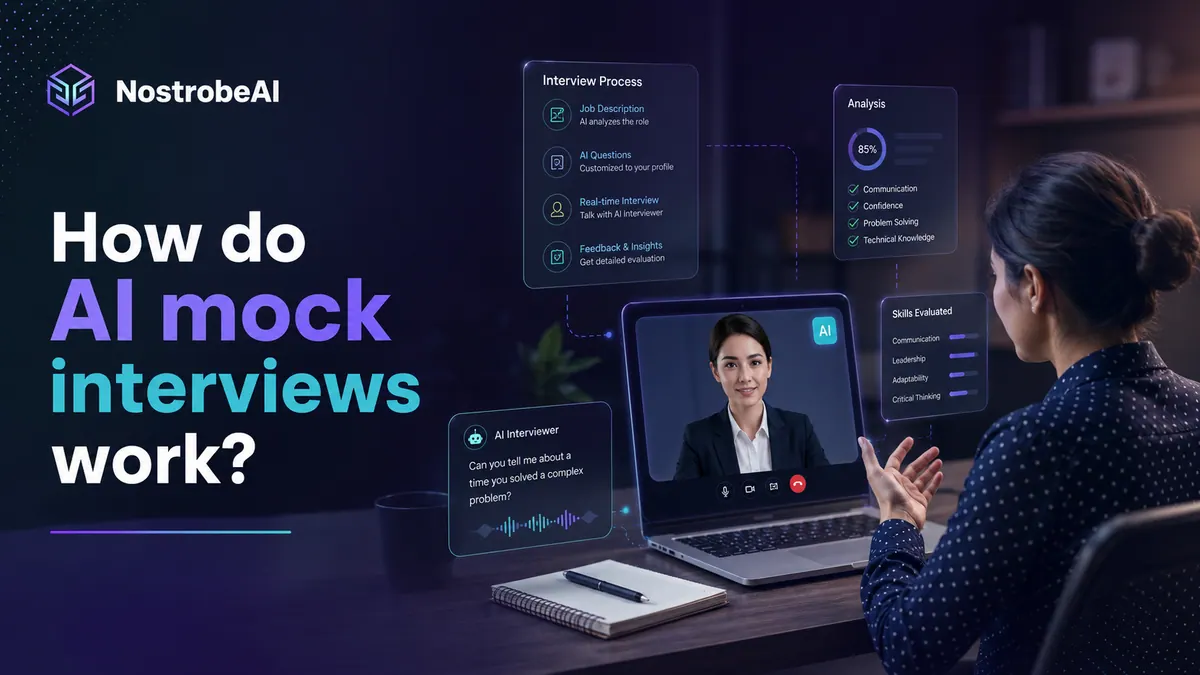
You upload a resume, paste in a job description, and pick an interview type: behavioral, technical, or HR round. The system reads both documents and builds a question set around your experience instead of pulling from some random bank. This is where people get surprised. If your resume says “led a team of six,” the AI might ask you to walk through a specific conflict you managed on that team, not just toss out “tell me about leadership” and move on.
Once questions start, you respond by voice, video, or text, depending on the platform. Speech-to-text engines convert what you say into text in real time, and that transcript becomes the raw material for everything that follows. Some tools also run facial expression tracking, using detection models to catch eye contact and expression shifts, paired with emotion classification to flag nervousness or hesitation. I find that part slightly unsettling, if I’m honest, having a camera judge my face while I’m sweating over a behavioral question. But it does catch things.
What is the AI actually scoring?
This is where people get it wrong. They assume it’s checking for keywords and calling it a day. It’s doing a lot more than that.
Most systems evaluate four layers at once: content relevance, delivery, structure, and pacing. Content relevance checks whether your answer actually addresses the question with specifics instead of vague filler. Delivery covers tone, confidence, and filler word count, things like how many times you say “um” or “like” in a two-minute answer. Structure often maps your response against the STAR framework: situation, task, action, result, to see if you’re telling a complete story or just rambling toward nothing. Pacing tracks how fast you talk and whether you rush through the part that actually matters, usually the result.
I tested one of these a few months ago and got flagged for talking too fast during the “result” section of a STAR answer. Never would have noticed that on my own. That’s honestly the strongest case for these tools. They catch things a friend giving feedback over coffee just wouldn’t pick up on, because a friend isn’t timing your pauses.
How does the feedback get so specific?
After you finish answering, the AI compares your transcript against a rubric built for that role and seniority level. It runs sentiment analysis and keyword matching against what a strong answer for that question typically includes, then generates a coaching note based on the gap. Newer platforms go further, producing a debrief covering logic, clarity, depth, data use, interaction quality, and overall structure.
Here’s a concrete example. Say the question is “Tell me about a time you disagreed with a manager.” A weak answer just describes the disagreement and stops there. The AI feedback would flag that you never explained the outcome or what you learned from it, then suggest rewording the ending to include a measurable result, maybe something like “After that conversation, we changed the process and cut turnaround time by two days.” That’s a fixable note. Compare that to a human friend saying “yeah, that was fine, maybe be more confident,” which tells you nothing you can act on.
Why does the AI adapt mid-interview instead of sticking to a script?
Some platforms don’t run a fixed list of questions. They read your previous answer and decide the next question based on it, the same way a real interviewer follows up when something you said raises another question. If you mention a number without explaining how you got there, expect a follow-up asking exactly that. This is the part that mirrors real interviews the closest, and it’s why these sessions feel less robotic than the old flashcard-style practice apps everyone used a decade ago.
I’ve noticed the follow-up questions tend to get sharper the more detail you give up front. Give a vague answer; get a vague follow-up. Give a specific one, and the AI digs into the specific part, almost like it’s testing whether you actually did what you claimed or just memorized a story.
Does this replace an actual human mock interview?
No, and most of the tool makers say that themselves. What it replaces is the friend-who’s-too-busy problem. You can run five practice rounds at midnight, get a scorecard each time, and track whether your STAR structure is actually improving without asking anyone for a favor. That’s genuinely useful for someone prepping for back-to-back interview rounds this week and needing reps, not another calendar invite to schedule.
The tradeoff is real, though. AI still misses things a good human interviewer catches, like whether your tone would land badly with a specific hiring manager, or whether a joke you made falls flat in that company’s culture. It also can’t tell you “hey, that answer sounded rehearsed,” because it’s a grading structure, not authenticity in the way a person would sense it.
So what’s the smart way to actually use one?
Run the AI sessions for volume and structure first. Use them to iron out rambling answers, cut filler words, and get your STAR stories tight. Then, closer to the actual interview date, do one or two live mock interviews with an actual person who can catch the things the algorithm can’t: tone, chemistry, whether your answer actually sounds like you and not a script.
Layering both gives you the repetition you need without losing the human read that ends up deciding whether you actually get hired. The algorithm gets you interview-ready on paper. A person still tells you whether you’d actually get along in the room.
Conclusion
AI mock interviews help candidates practice in a realistic environment, improve communication, and receive data-driven feedback before actual interviews. Regular practice builds confidence, identifies weak areas, and strengthens interview performance, making AI interview preparation a practical step toward better career opportunities.
Frequently asked questions
How do AI mock interviews work?
AI mock interviews simulate real interview scenarios by asking role-specific questions, analyzing your responses, evaluating communication, and providing detailed feedback on strengths, weaknesses, confidence, and overall interview performance.
Are AI mock interviews suitable for freshers?
Yes. They help freshers practice common interview questions, improve speaking skills, build confidence, and understand interviewer expectations before attending their first job interview.
Can AI interview practice improve communication skills?
Yes. Regular AI interview practice helps improve clarity, vocabulary, response structure, pacing, and confidence through continuous feedback and repeated practice sessions.
Do AI mock interview tools ask technical questions?
Most AI mock interview tools include technical, behavioral, situational, and role-specific questions based on your industry, experience level, and target job position.
How accurate is AI feedback after a mock interview?
AI evaluates measurable factors like speech, response quality, confidence, and structure. While helpful, combining AI feedback with human guidance often provides more balanced interview preparation.
Can I practice interviews for different job roles?
Yes. Most AI interview platforms allow users to customize interview sessions for software engineering, marketing, finance, sales, customer support, management, and many other professions.
How often should I take AI mock interviews?
Practicing two or three sessions each week helps improve consistency, strengthen responses, identify recurring mistakes, and prepare effectively for upcoming interviews.
Do AI mock interviews help with behavioral interview questions?
Yes. They include behavioral questions based on workplace situations and provide suggestions to improve answer structure, storytelling, confidence, and relevance.
What equipment do I need for an AI mock interview?
A computer or smartphone, stable internet connection, microphone, webcam, and a quiet environment are usually enough to complete an effective AI mock interview session.
Can experienced professionals benefit from AI interview preparation?
Absolutely. Experienced professionals use AI interview preparation to refine leadership responses, prepare for career transitions, practice executive interviews, and improve overall communication before important opportunities.